


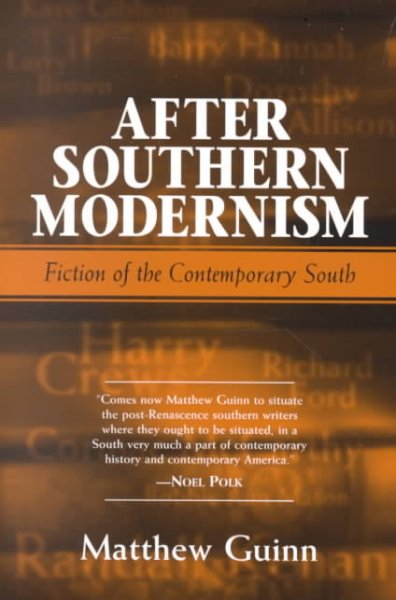
After Southern Modernism $25.00
Jackson, MS: University Press of Mississippi (2000)
The literature of the contemporary South might best be understood for its discontinuity with the literary past. At odds with traditions of the Southern Renascence, southern literature of today sharply refutes the Nashville Agrarians and shares few of Faulkner’s and Welty’s concerns about place, community, and history.
This sweeping study of the literary South’s new direction focuses on nine well established writers who, by breaking away from the firmly ensconced myths, have emerged as an iconoclastic generation- — Harry Crews, Dorothy Allison, Bobbie Ann Mason, Larry Brown, Kaye Gibbons, Randall Kenan, Richard Ford, Cormac McCarthy, and Barry Hannah. Resisting the modernist methods of the past, they have established their own postmodern ground beyond the shadow of their predecessors.
This shift in authorial perspective is a significant indicator of the future of southern writing. Crews’s seminal role as a ground-breaking “poor white” author, Mason’s and Crews’s portrayals of rural life, and Allison’s and Brown’s frank portrayals of the lower class pose a challenge to traditional depictions of the South. The dissenting voices of Gibbons and Kenan, who focus on gender, race, and sexuality, create fiction that is at once identifiably “southern” and also distinctly subversive. Gibbons’s iconoclastic stance toward patriarchy, like the outsider’s critique of community found in Kenan’s work, proffers a portrait of the South unprecedented in the region’s literature. Ford, McCarthy, and Hannah each approach the South’s traditional notions of history and community with new irreverence and treat familiar southern topics in a distinctly postmodern manner. Whether through Ford’s generic consumer landscape, the haunted netherworld of McCarthy’s southern novels, or Hannah’s riotous burlesque of the Civil War, these authors assail the philosophical and cultural foundations from which the Southern Renascence arose.
Challenging the conventional conceptions of the southern canon, this is a provocative and innovative contribution to the region’s literary study.
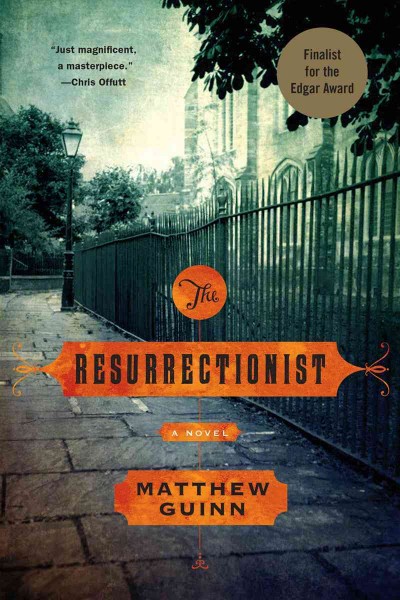
The Resurrectionist $14.95
New York, NY: Norton (2014)
“Dog days and the fresh bodies are arriving once again.” So begins the fall term at South Carolina Medical College, where Dr. Jacob Thacker is on probation for Xanax abuse. His interim career working public relations for the dean takes an unnerving detour into the past when the bones of African American slaves, over a century old, are unearthed on campus. Out of the college s dark past, these bones threaten to rise and condemn the present.
In the middle of the nineteenth century, Dr. Frederick Augustus Johnston, one of the school s founders, had purchased a slave for his unusual knife skills. This slave, Nemo (“no man”) would become an unacknowledged member of the surgical faculty by day and by night, a “resurrectionist,” responsible for procuring bodies for medical study. An unforgettable character, by turns apparently insouciant, tormented, and brilliant, and seen by some as almost supernatural, Nemo will seize his self-respect in ways no reader can anticipate.
With exceptional storytelling pacing and skill, Matthew Guinn weaves together past and present to relate a Southern Gothic tale of shocking crimes and exquisite revenge, a riveting and satisfying moral parable of the South.”
The Resurrectionist $25.95
New York, NY: Norton (2013)
A young doctor wrestles with the legacy of a slave “resurrectionist” owned by his South Carolina medical school.
Nemo Johnston was one of many Civil War-era “resurrectionists” responsible for procuring human corpses for doctors’ anatomy training. More than a century later, Dr. Jacob Thacker, a young medical resident on probation for Xanax abuse and assigned to work public relations for his medical school’s dean, finds himself facing a moral dilemma when a campus renovation unearths the bones of dissected African American slaves–a potential PR disaster for the school.
Will Jacob, still a stranger to his own history, continue to be complicit in the dean’s cover-up or will he risk his entire career to force the school to face its dark past?
First-time novelist Matthew Guinn deftly weaves historical and fictional truth, salted with contemporary social satire, and traditional Southern Gothic into a tale of shocking crimes and exquisite revenge–and a thoroughly absorbing and entertaining moral parable of the South.
A native of Atlanta, Matthew Guinn holds degrees in English from the University of Georgia, the University of Mississippi, and the University of South Carolina, where he was personal assistant to the late James Dickey. He lives in Jackson, Mississippi.
Thursday September 10, 2015
Signing: 5:00
Reading: 5:30
The Scribe $25.95
New York, NY: WW Norton (2015) As new in dust jacket.
Available in August 2015. Pre-order a signed copy!
On the eve of Atlanta’s 1881 International Cotton Exposition, disgraced former detective Thomas Canby is called back to the city to track a serial murderer who seems to be targeting its wealthiest black entrepreneurs. The killer’s method is both strange and unusually gruesome: on each victim’s body, a letter of the alphabet is inscribed. Intent on shielding the city’s celebration of New South industry, its most prominent businessmen—“the Ring”—pressure Canby to tie up the case. Paired with Atlanta’s first African American officer, Cyrus Underwood, Canby must face down enduring racism, and his own prejudices, to see clearly the source of these bloody crimes. Meanwhile, if he can restore his reputation, he might win back the woman he loves. With scrupulous attention to historical detail, Edgar Award finalist Matthew Guinn draws readers into a vortex of tense, atmospheric storytelling, confronting the sins and fears of both old South and new.