As soon as I got into the introduction of Canoeing Mississippiby Ernest Herndon I realized that this was not just a book for canoeing enthusiasts. Anyone interested in our natural state, our abundance and variety of rivers will find the armchair travel delightful.
You might not immediately associate Mississippi with canoeing but Herndon describes over 2,000 miles of waterways. Yes, some of these are muddy and mosquito filled! However, Herndon does us a great service describing the great variety of rivers we have: the 150-mile long Chunky River which makes it way through rocky cliffs into the Buckatunna; the heavily wooded Leaf River; the whitewater Okatoma; the Tangipahoa which flows into Lake Ponchartrain; the 400-mile long Pearl River running from Northeast Mississippi all the way to the Honey Island Swamp, including the beautiful Bogue Chitto River as its tributary; and finally our Gulf Coast terrain includes the complex, ever-changing Wolf River.
Okatoma River
If you decide to leave your armchair for the canoe, you’ll benefit from Herndon’s 30-plus years of experience of canoeing in Mississippi. River by river you’ll learn about boats and gear, paddle strokes, camping and navigation. To enrich your float, you’ll find Canoeing Mississippi to also be an abundant source on history and adventure stories, geology, wildlife, ecology and fishing techniques.
Bogue Chitto River in Pike MS by Greg GibsonCanoes on the Wolf River
I just returned from a 2 week trip to the Pacific Northwest for a graduate school residency. Out on Whidbey island, a stone’s throw from Puget Sound, I went on long walks along the coast and took the ferry to Port Townsend, a quaint port town with some good bookshops. (I’m including some photos I took so you can enjoy the views, too.)
At one such shop, I bought Terry Tempest Williams’ When Women Were Birds. William’s has worked throughout her career as an environmental activist and as a result, much of her work focuses on our relationship with the natural world. However, in When Women Were Birds, Williams focuses on her relationship with her family, her mother in particular.
Upon her death, Terry Tempest Williams’ mother left her all of her journals. The journals were all blank. Spurred on by this mysterious silence on the page, Williams, in 54 small essays, explores voice–what it means to both speak and be silent. With poetic prose, she ventures into her relationship with her mother, her Mormon faith, and her own writing voice.
Even the beautiful Washington coast couldn’t pull me away from this book, and I highly recommend it to mothers and daughters, wives, artists, and women of faith. Terry Tempest Williams charts the female coming-of-age with poignancy and language that is sure to curl your toes.
Here’s one of the shorter essays:
Conversation is the vehicle for change. We test our ideas. We hear our own voice in concert with another. And inside those pauses of listening, we approach new territories of thought. A good argument, call it a discussion, frees us. Words fly out of our mouths like threatened birds. Once released, they may never return. If they do, they have chosen a home and the bird-words are calmed into an arts poetica. The women in my family didn’t always agree, but it was in their comp
My friends have been frantically buzzing about the second season of the HBO series Girls. They generally feel ripped off: the characters’ dark sides and relationships are unraveled at breakneck speed, when all that devoted viewers wanted was more reason to love those quirky, young New Yorkers from season one. The characters have turned no new corners; loose ends have simply curled up into balls at the conclusion of the season; and everyone is getting back together with their old boyfriends. How can we experience empathy among all this mess? Who do we root for?
Regardless of what their opinions say about Girls as we await season 3, they say a lot about fiction. We want fiction and television to make us see a familiar world in a fresh way. We want to empathize with the world, and in turn to feel our burden is shared. This is what good writing does for us, whether or not we ever talk about it. Here’s some news, bros: I have a novel that does this super well. (And it, like Girls, is written by a woman.)
With each “turn of the screw” in A. M. Homes not-quite-so-new-anymore (sorry!) novel May We Be Forgiven, something clicks, something charms, and I laugh. I mean, it’s no funny novel – more like an epic, but our narrator, Harry, says and does things that are framed in such a way as to make me laugh. He is losing his mind and regaining it over and over again just like I do nearly every day; unfortunately, I don’t laugh at myself quite as much. A wild thing about humanity is that even among suffering, mental illness, death, we still have to brush our teeth and bathe the dog. Here, Harry takes care of a dog (among other things) that belongs to his mentally unstable, murderous brother, and Homes writes the relationship to be both beautiful and funny (not quite so heartbreaking as it was in The Dog Stars). At the halfway point, I am already grateful for this novel. As Homes’ novel forgives the characters – convinces us to see the heart in Harry, we remember to also care for the demons, fears, and the heart in ourselves.
And greatest of all, by virtue of its being a book, the entire saga is written BEFORE you start reading it. I wouldn’t say to give up on Girls, but good luck suspending your judgment until the end of the next season. Whether you feel that you lose or win at that point, don’t forget that novels are here for you, loyal as the family dog.
David Hinton is one of my favorite translators of Chinese poetry. I’ve enjoyed many of his works, of which Mountain Home stands out and might be my favorite. I was excited when I received his own Hunger Mountain, his account of a series of walks up and down a mountain near his Vermont home.
As David walks, he also weaves a human consciousness into his natural environment exploring the texture of his own experience. Transcendental moments open windows into ourselves. For us his reader, we can use his walk to explore our own internal culture. While walking with David, we address the textures and fundamentals of our own everyday experiences. Through his wisdom we begin to truly see more of who we are and better understand our cultural landscape.
The lessons (or chapters) are focused on real life issues. Chapter one “Sincerity” sets the tone of this transforming essay collection. We want to see our lives as clearly as possible, and David uses his many years of understanding the great Chinese masters to adapt nature as poetry as he translates his musings.
Hunger Mountain offers us a spiritual ecology of walking, using natural happenings to express how things arise and pass away, how our observances reappear transformed into other generating forms. Hunger Mountain is a walking meditation where we watch the process of forming our thoughts, as they come and go, moving us deeper into who we are.
I consider my experience reading Hunger as a personally transforming prose poem itself. For me, it is a book length poem, a meditation to help the reader find out more about their truest self. To read poetry this way is how I learned to enjoy reading poems. Using the hidden, the unsaid, to fill in the gaps helps me address dormant emotions. That is the diamond of joy that a real reading experience can bring.
If you want to explore you inner ecology, treat yourself to the pleasure of transforming yourself on Hunger Mountain.
* * *
A mountain can be a great teacher–not only because it manifests the cosmology of sincerity and restless hunger with such immediacy and drama, but also because it stands apart, at once elusive and magisterial. Walking up Hunger Mountain today, its imposing and indifferent presence reminds me yet again that things in and of themselves remain beyond us, even after the most exhaustive and accurate scientific or philosophical account , the most compelling mythology, or the most concise and penetrating poem.
History has shown us that the art of talking trash started eons ago, back when Cain first said to Able “Hey bro, sweet veggies. Nice parsnips! Oops, I meant parsNOPES. Boom!” Sadly, in the past decades, the hallowed hall honoring some of history’s greatest talkers of trash (Ben Franklin and Winston Churchill have prominent, lamp lighted-portraits hanging directly in the middle) has become increasingly empty. Young potential students, wandering aimlessly across the fields of fruit ripe for the bashing have no teachers, no Obi Wans to guide them or tell them to wait until the moment is perfect. Emily has shown us that.
With that being said, allow me to gracefully introduce you to my final two contestants in this competition.
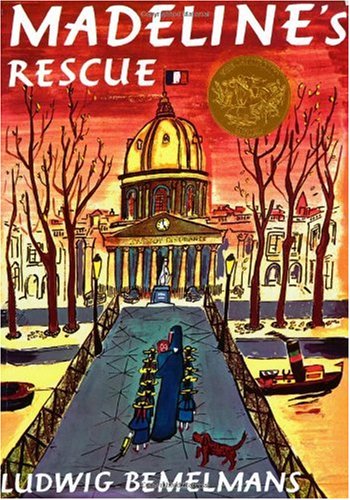
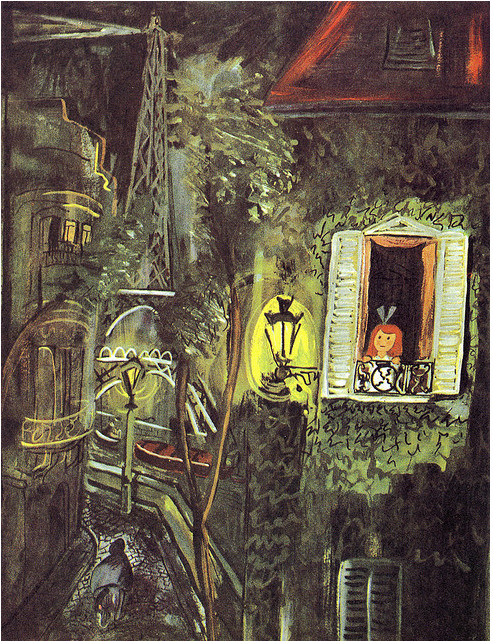
I favor an older school of illustrating, one that puts emphasis on both originality and talent. (This is probably why I can’t get behind Chris Raschka, another Caldecott winner–check him out and make up your own mind, you may love him) It’s this perfect combination of artistry and imagination that makes Madeline’s Rescue by Ludwig Bemelmans such an amazing pick for this competition. As the story of Madeline, her classmates, and the ever-watchful Miss Clavel unfolds to introduce Genevieve the dog, Bemelmans moves seamlessly from childlike pen and ink drawings to breathtaking scenes of Paris that are playfully detailed, making it no wonder that it won the Caldecott in 1954.
It’s a normal day for the twelve little girls in two straight lines until Madeline falls in the river and is rescued by a heroic dog named Genevieve. Naturally the girls take Genevieve home to live with them and of course the board of trustees chooses this time to visit and expel the life saving canine with the awful words “DOGS AREN’T ALLOWED IN SCHOOL”. The girls and Miss Clavel spring into action! Will they find their beloved Genevieve again?
Parents just DON’T understand! Um, I mean trustees.
In the end, all is as it should be, twelve little girls in two straight lines who left the house at half past nine in rain or shine….plus maybe a dog or two extra.
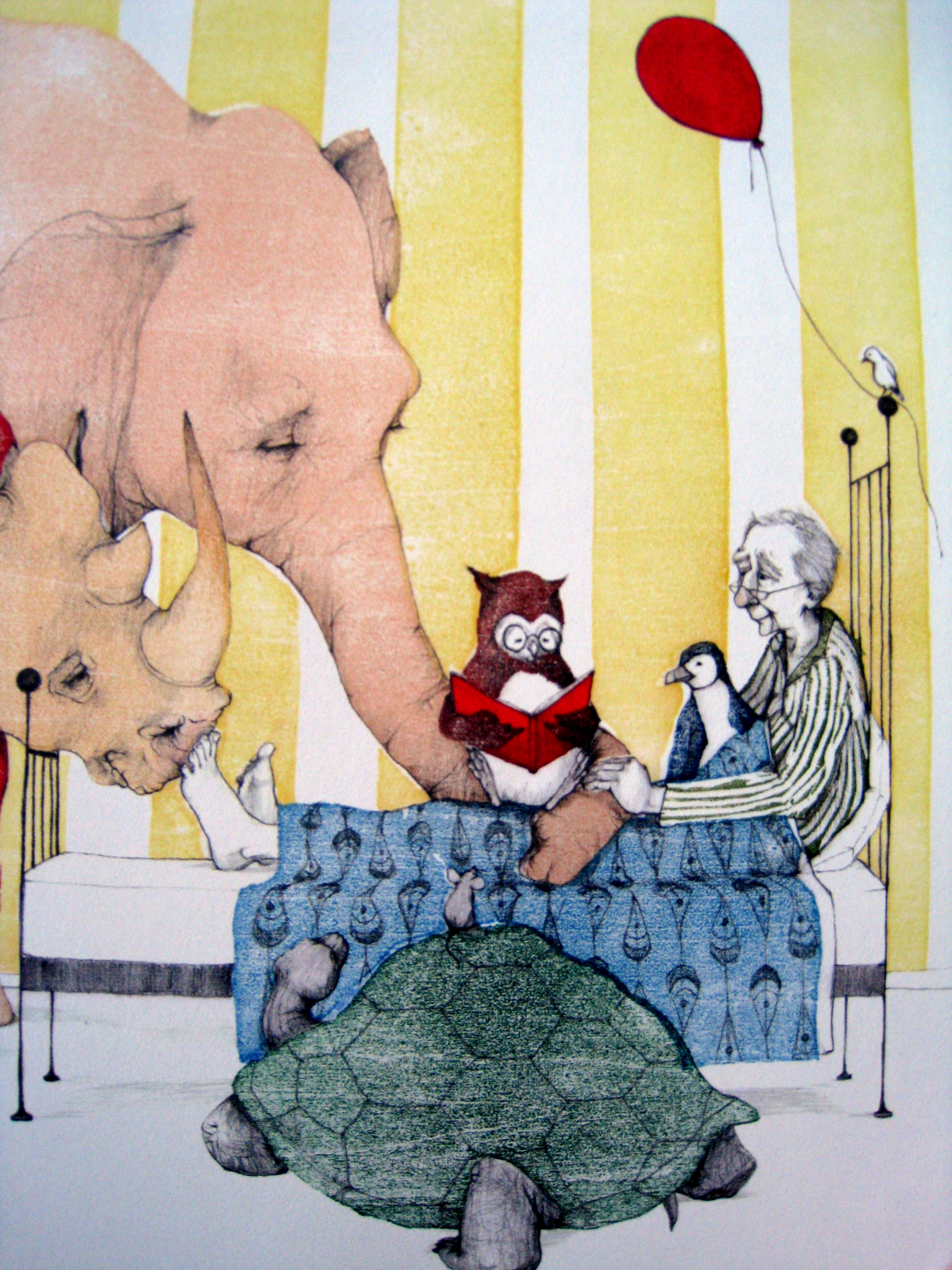
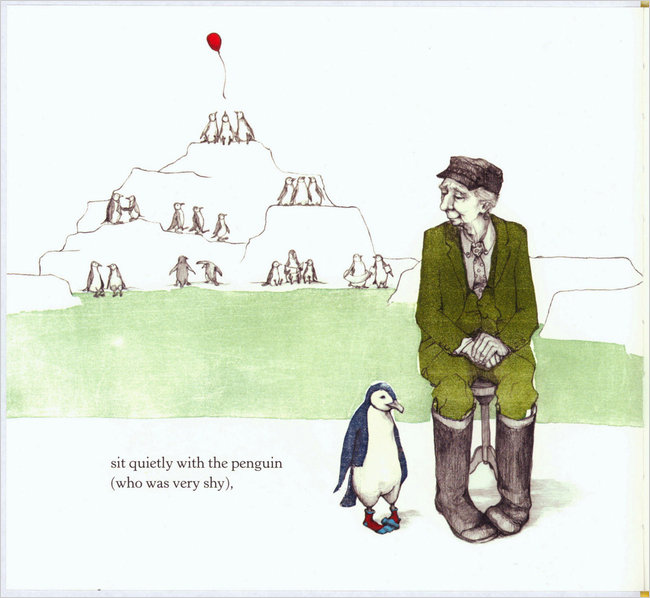
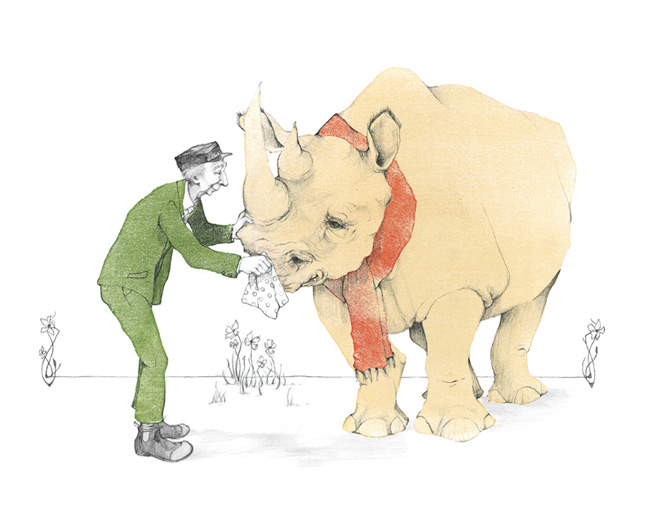
You want more unbelievable fabulousness you say? Alright, first of all, calm down. Second of all, let me tell you about Amos and his perfectly sweet menagerie of friends. Teaming up to win the Caldecott in 2011, husband and wife duo Philip and Erin Stead (He writes, she illustrates) created an amazing book called A Sick Day for Amos McGee. This story chronicles a few days in the life of Amos, an elderly zookeeper who takes such good care of his animals that when he is taken sick one day, they decide to go to his house to take care of him in turn. Touching without being syrupy, this book is the cream of the crop. And the illustrations! Oh please can we talk about these illustrations for a minute? Combining the old school with the new Erin Stead gives us graceful pencil sketches that experiment with the back and forth between black and white and color. But that’s enough of me describing, just look at them. In this case, a picture really is worth a thousand words. (Or points.)
And that’s all, folks. We’ve limited ourselves to five contestants each and I truly believe that I picked the best of the best. What I’m going to do now is pick my absolute favorite one from the five I have chosen, which is hard because it’s like picking a favorite child, but here goes…..[pause while I walk away and do some shelving because this actually deserves some serious thought]…Ok, it’s been about 30 minutes and not only did I have a short visit with my mother in the store, I have also picked a favorite. It’s Amos. I love Mirette her red-headed determination. I love Sylvester and his silly blunderings, and I love, love that industrious Ox Cart Man. And gosh I love Madeline. But I honestly believe that A Sick Day for Amos McGee is the perfect blend of good storytelling and masterful art. It seems now that it would be silly to choose anything else. I await your final contender with great anticipation, Emily Grossenbacher.


 As soon as I got into the introduction of Canoeing Mississippi by Ernest Herndon I realized that this was not just a book for canoeing enthusiasts. Anyone interested in our natural state, our abundance and variety of rivers will find the armchair travel delightful.