The Commoner by John Burnham Schwartz

March 12, 2008 by

commonerAt the age of twenty-four Haruko, a commoner, marries the Crown Prince of Japan, becoming the first non-aristocratic woman to do so. She, an accomplished, well-educated woman, enters a life controlled by the Empress and her minions—one where she no longer has an identity of her own. She suffers a nervous breakdown, but eventually recovers and perseveres. Thirty years later, now Empress herself, she plays a crucial role in persuading another commoner to accept her son’s proposal.
Though histories of certain members of the Japanese Imperial family were an inspiration for the story, it is a product of fiction. However, it is a timely and relevant one—-a fascinating and enjoyable read.

-Yvonne


Life Class by Pat Barker

March 10, 2008 by

life classRegeneration, the first book of Pat Barker’s trilogy about WWI, is the most powerful anti-war book I’ve ever read, and one of the best pieces of historical fiction I’ve ever read as well. Her latest book, Life Class, revisits WWI but not as successfully as the Regeneration Trilogy. The book is divided into two parts. Part One is set on the eve of WWI and follows the lives of three characters—Paul, Neville and Elinor—all art students studying at a famous art school in London called the Slade. Their lives revolve mostly around their studies and their romantic liaisons. Frankly I found this part of the book to be rather slow, and the characters not particularly engaging or appealing. But in Part Two of the novel, the narrative comes alive. Ms. Barker herself seems much more engaged. Her writing becomes more vivid and certainly more compelling , as the reader is thrown into the midst of WWI when the two male characters volunteer for the medical corps. Ms. Barker seems to have a unique grasp of the horror and tragedy of war and she manages to convey it best through the lens of WWI. This aspect alone makes the novel worth reading. I’m sure the main reason I found the book somewhat disappointing was that I couldn’t help but compare it to Regeneration. Anyone who has not read the earlier trilogy would undoubtedly find Life Class a compelling and powerful piece of historical fiction in its own right. -Billie


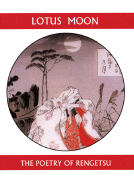
Lotus Moon: The Poetry of Rengetsu

March 6, 2008 by

Lotus Moon: The Poetry of Rengetsu
Translated by John Stevens
White Pine Press (2005)
Japanese poet, Rengetsu (1791-1875), was the illegitimate offspring of a high-ranking Samurai and a young geisha. In her youth she was visited by severe tragedy (deaths of two husbands and three infant children). She became a Buddhist nun taking the name Lotus Moon. Her world attempted to limit her on the basis of gender, however, she realized art was her path. As moving meditation she began making pottery. She learned martial arts, literature and calligraphy. Keeping few possessions she likened herself to a “drifting cloud.” Incredibly prolific, she has given us one of the most generous, sustained offerings of deep spiritual practice in Buddhist history. She left her fine poetry as a legacy.

Lotus Moon offered me many favorites. Here are three examples:

“Mountain Falling Flowers”

We accept the graceful falling
of mountain cherry blossoms,
But it is much harder for us
To fall away from our own
Attachment to the world.

“Summer Moon”

The cool shadows
of the bright moon
In an open field
makes you forget
all daytime worries.

(Perhaps my favorite)
“Evening Cool by the Sea”

Cooling off in a boat
that sways as if drunk-
in the bay breeze
the moon on the waves
seems a bit tipsy too!

.
Reading Rengetsu for the first time was enjoyable, pleasant and reflective. However, I feel repeated reading in the future will broaden my perceived simplicity into something more complex. Lotus Moon is the second of my girl poet reading project.


Moneyball by Michael Lewis

March 5, 2008 by


Every once in a while I come across a book that I missed the first time around. I know everyone else has already read Moneyball, but until recently I hadn’t — and now that I’ve read it, I agree that every self-respecting baseball fan needs to read it.

Much has been made about Billy Beane (Oakland A’s general manager) and his statistical approach to assembling a team. The oft-repeated caricature of Beane and his ilk as a bunch of math-obsessed nerds misses the point. The stats-geeks love baseball as much as the traditionalists — they just have an unquenchable desire to understand the nuts and bolts of the game, instead of relying solely on their immediate perception of players and teams. Michael Lewis narrates the battle between the new-school statistical approach and the old-guard “Baseball Men” (a club restricted mostly to former players and scouts), and follows Beane’s path from a failed prospect (who was described as “can’t-miss” by the old guard) to a major league general manager assembling overlooked and ignored players into a playoff team.

If you’re gearing up for baseball to start (March 25th!), and you haven’t read Moneyball yet, definitely grab a copy. It’s a great read and will definitely change the way you understand the game.


Mudbound by Hillary Jordan

by

mudboundI must confess that I haven’t read much Southern Fiction lately. I have been swimming in a sea of intrigue (I cannot get enough of Tudor England) and blood (I have taken over the mystery section)! That being said, I wasn’t really sure that I was going to like Mudbound when Joe brought me an advanced copy and asked me to take a look at it. I took it home to read a few chapters over the weekend and came back to work on Monday having finished the book and let everyone know that I loved it!

The story takes place in the Mississippi Delta in 1946. It centers around two families, The McAllans and The Jacksons. The Jacksons are share tenants on the McAllan’s recently purchased farm. Laura McAllan is trying to learn “the ropes” of country living and enlists the help of Florence Jackson to help her around the house. Both families have family members fighting in the war, Laura’s bother-in-law, Jamie and Ronsel, the eldest Jackson son. Both men come home around the same time and develop a secret friendship that causes trouble for both families. “The men and women of each family relate their versions of events as they see them, and we are drawn into their lives as they become players in a tragedy on the grandest scale.”

Hillary Jordan grew up in Texas and Oklahoma. Mudbound is her first novel and has been awarded the 2006 Bellwether Prize, founded by Barbara Kingslover to recognize literature of social responsibility. She will be signing and reading at Lemuria on Thursday, March 20, 2008 at 5:00. Please come by and congratulate her on this novel whose characters and storyline will stay with you long after you have finished this story of the Jim Crow South.

“This is storytelling at the height of its powers: the ache of wrongs not yet made right, the fierce attendance of history made as real as rain, as true as this minute. Hillary Jordan writes with the force of a Delta storm.” –Barbara Kingsolver